
How an AI UGC Video Generator Works: From Product Photo to Creator-Style Clip
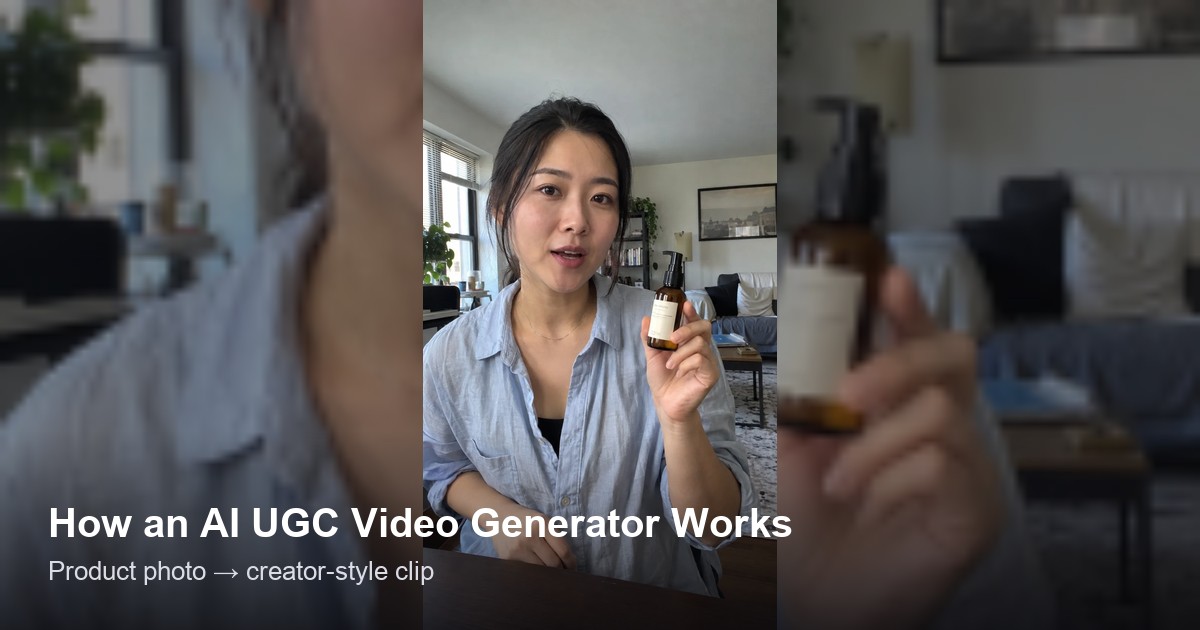
An AI UGC video generator turns a short idea and optional product photos into a creator-style clip — the kind of vertical, everyday framing you see in demos, unboxings, and lifestyle beats. Before you open Create, you need a hard definition of what AI UGC is (and what it is not), then a clear workflow from brief to QA.
This is the educational how-it-works piece. Clipin's product home stays on clipin.ai — Your product. A creator-style story. Use this page for the job, the formats, and the rejection rules so generated content never gets confused with real social proof.
What is AI UGC? (hard definition)
AI UGC means generated creator-style content: short-form video (or stills) produced by an AI system so that a product appears inside an everyday, phone-native story beat — the kind of framing people associate with user-generated clips on TikTok, Reels, Shorts, and similar feeds.
Hold the boundary in one sentence:
AI UGC ≠ real customer testimonials / authentic buyer UGC.
It is not footage from a real purchaser. It is not a permissioned review. It is not "proof that someone bought and loved the SKU." It is a generated creative asset you can use for demos, unboxings, lifestyle placement, and explainers — then disclose and place according to your channel's rules.
An AI UGC video generator is the tool class that takes a brief (text) and optional reference images (product still, packaging, sometimes an avatar) and outputs a vertical or feed-ready clip in that creator-style register. Clipin is one such generator, focused on product-first stories: the SKU should stay recognizable, not dissolve into a generic bottle.
Why the definition comes first
Teams mix up AI UGC with real buyer footage all the time — in briefs, in ad reviews, and in stakeholder decks. A cite-worthy definition up front keeps the rest of the workflow honest: you get a practical picture of how an AI UGC video generator works, without inventing traffic volumes or competitor rankings, and without claiming that generated clips are authentic buyer proof.
When to use an AI UGC video generator (and when not to)
Jobs it is good for
Use an AI UGC video generator when the job is creative production, not social proof:
| Job | What "good" looks like |
|---|---|
| Product demo / hands-on | SKU readable in hand or on a surface; one clear action (pick up, tap, spritz, open) |
| Unboxing / reveal | Package → open → product readable; one tactile detail optional |
| Lifestyle / everyday placement | Product in a believable desk, bathroom, kitchen, or commute beat — still SKU-true |
| Explainer / soft intro | Short "what it is / how you'd use it" without a cinematic brand film |
| Multi-scene Story | Hook → demo → lifestyle → CTA arc when one 5–15s beat is not enough |
Typical inputs: a pack shot or iPhone product photo, a two-line idea (action + tone), and optionally a template that already encodes the beat. Typical outputs: a creator-style clip you review before anyone else sees it. Generation does not auto-publish to ads or social.
When not to use it
Do not use AI UGC as a stand-in for:
- Real customer testimonials or review screenshots you do not have permission to use
- Authenticated buyer footage required by a platform or legal team
- Guaranteed performance creative ("this will win the ROAS test")
- Claims the product cannot support (medical, financial, results language you would not put on the PDP)
If your brief is "we need proof people bought this," hire creators, collect real reviews, or run a permissioned UGC program. If your brief is "we need a readable product-in-story draft this week," an AI UGC video generator is the right class of tool.
For paid-social compliance depth (disclosures, claim language, creative test matrix), use the dedicated playbook — one pointer only: AI UGC Ads Playbook. This how-it-works article does not rewrite that matrix.
How Clipin works: from brief to review
Clipin's flow is intentionally short. Think idea → optional references → Create and/or templates → QA, not "upload a URL and wait for fifty variants."
1) Start with a brief (not a screenplay)
Write two lines:
- Action — what happens to the product in frame
- Tone + format — casual / messy apartment / 9:16 / duration you intend to set in Create
Example (headphones):
Reference: black over-ear headphones; keep silver hinge and ear-cup logo.
Scene: real desk, laptop half-closed, afternoon window light.
Action: pick up, put on, tap the cup once, slight smile to camera.
Tone: quiet, conversational. No hard sell. No invented reviews.
2) Add optional reference images
A clean hero still beats a busy lifestyle collage for the first run. Front 3/4, label readable at phone width, true colorway. Packaging shots help unboxing templates. Avatar upload/create is marketed for templates that need a person — treat live template requirements as source of truth.
3) Create and/or templates
Two on-ramps:
- Templates — pick a beat that already exists (hands-on, unboxing, lifestyle, product motion), swap in your photo, adjust the idea.
- Create — blank modes: Video, Image, Story (and Agent where shown). Choose model, aspect ratio, duration, review the credit estimate, then generate.
Anonymous visitors can open Create and inspect controls; Generate / Start hits a sign-in wall (Google; new accounts can be created). Scene editing, download, and publish paths require a signed-in session. Clipin does not auto-publish results to social or ad accounts.
4) QA / review before anyone else sees it
Treat the first output as a draft. Play it at phone width. Apply the kill checklist below. Change one variable per rerun (crop, brief wording, or template) — do not rewrite the brand between attempts.
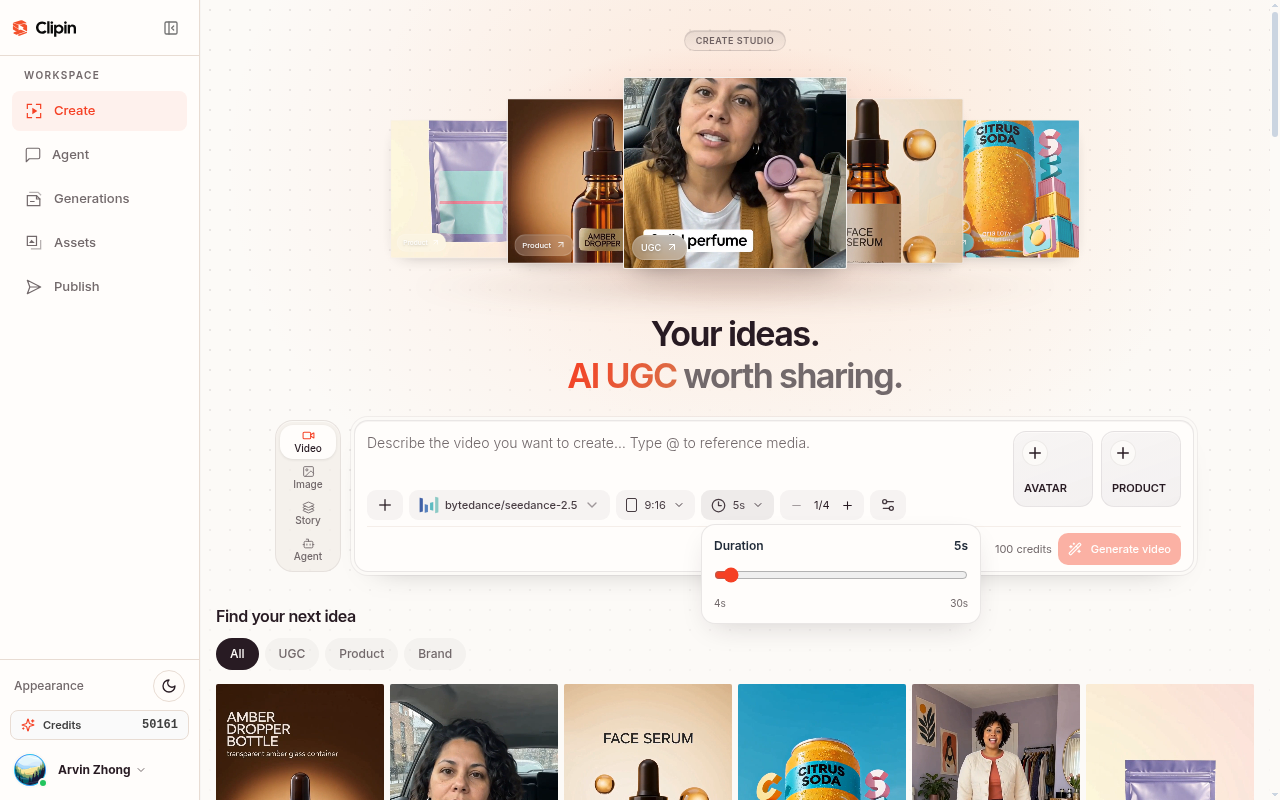
Create → Video (observed 2026-09-19): duration is a slider — confirm live ends and default on /create. Settings can change.
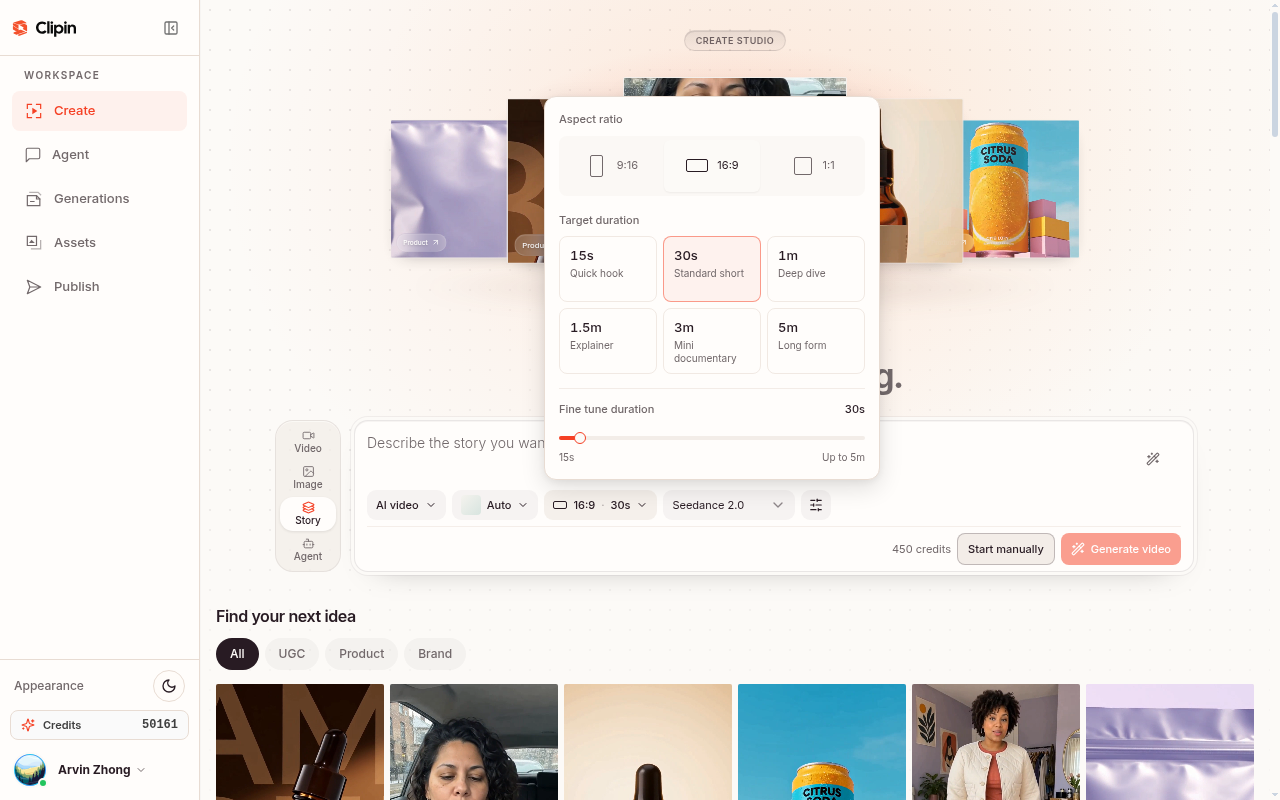
Create → Story (observed 2026-09-19): target duration chips and fine-tune — confirm live UI. Story estimates are often higher than a short single Video clip.
Duration truth (do not invent a global max)
Operators confuse three different numbers. Keep them separate:
| Source | What it usually means |
|---|---|
| Template marketing default | Often ~15s in 9:16 (some demo captions say ~10s) — demo / default for that template, not Create max |
| Create → Video | Duration slider observed roughly 4s–30s (default often near the short end) — confirm on /create |
| Create → Story | Duration chips observed from 15s (quick hook) through 5m (long form), with fine-tune in that range — confirm on /create |
Prefer this ops phrasing: duration varies by model and settings — confirm on /create. Template defaults are starting points, not platform ceilings.
Formats: hands-on, unboxing, lifestyle, and Story
Match the job to a format before you invent a blank prompt. Gallery: templates.
Hands-on / product in use
Best when the product should feel held, tried, or demonstrated in one beat.
- Template: Product in your hands — marketing default often 15s · 9:16; clear product photo recommended.
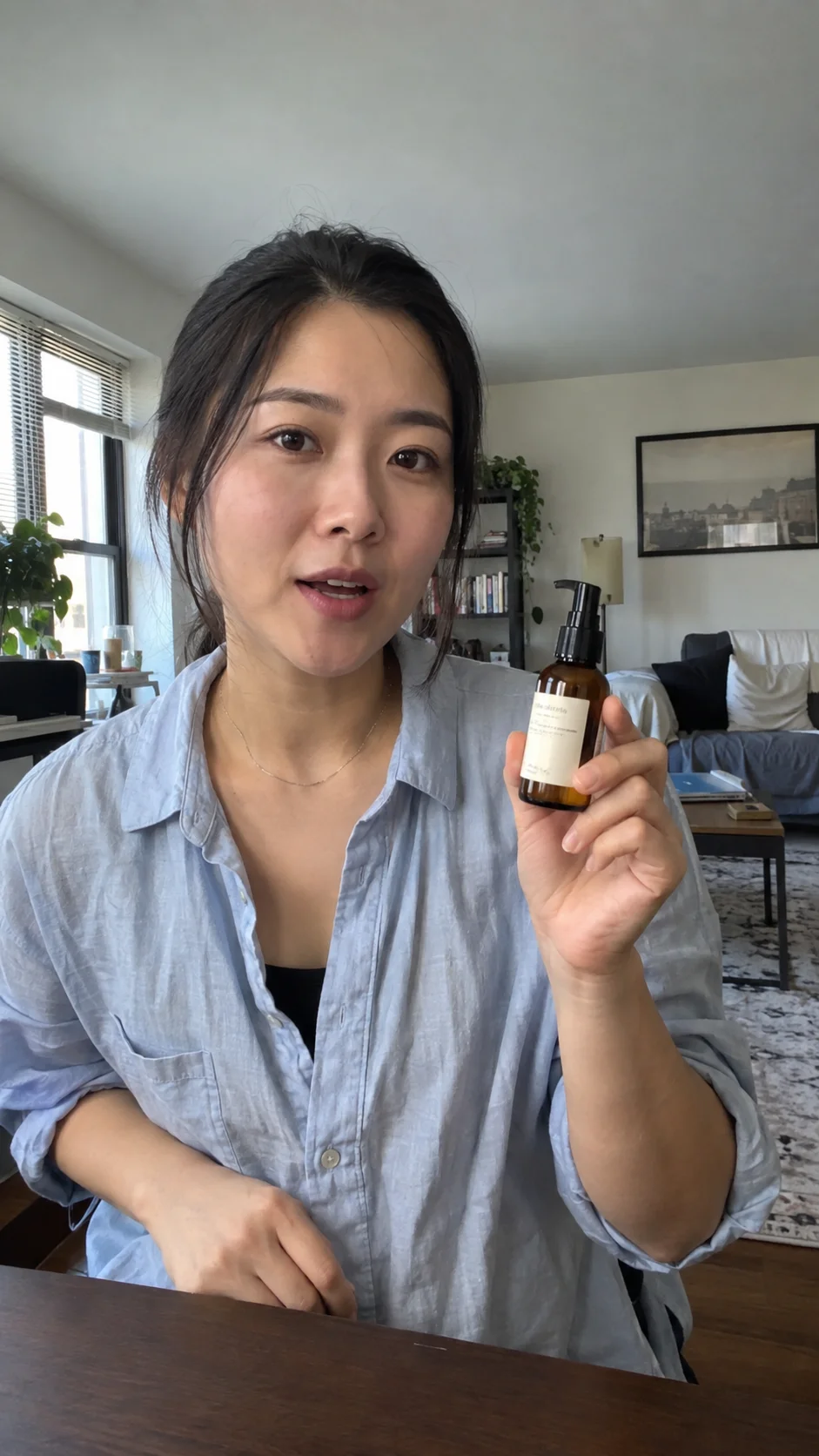
Product in your hands — hands-on creator-style beat. Generated examples · results may vary.
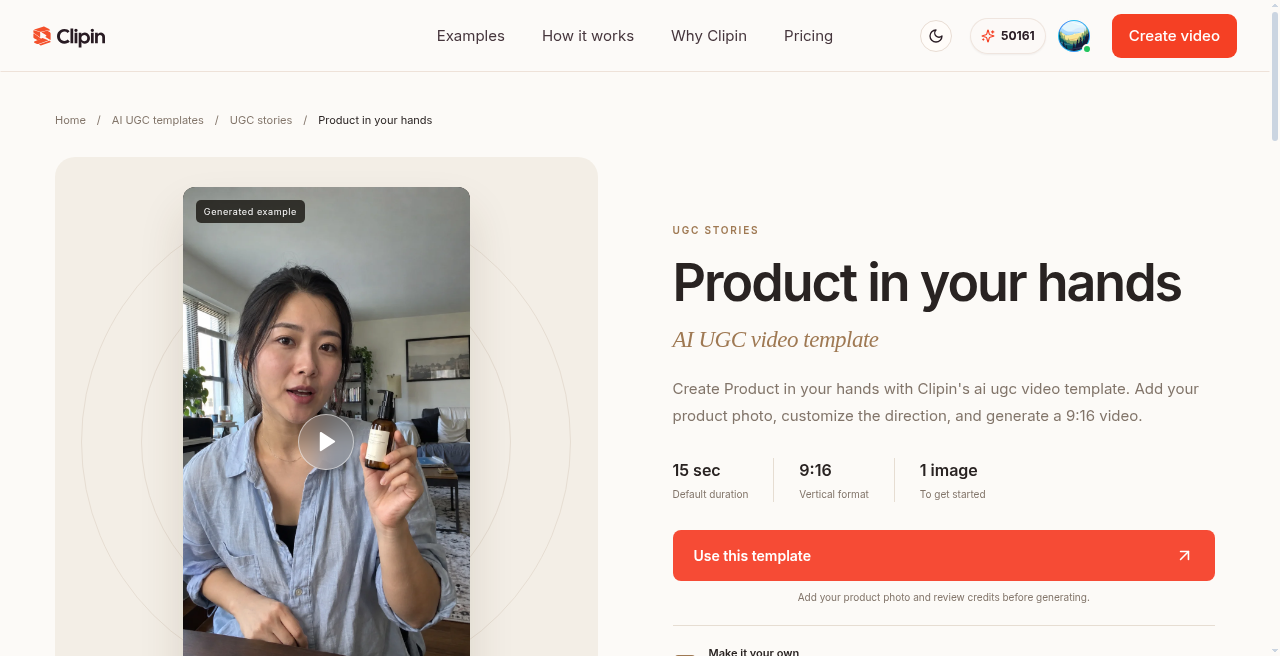
Live template card pattern: default duration often 15 sec, vertical 9:16 — template default, not Create max.
Unboxing / reveal
Best when the story is package → open → product readable.
- A little unboxing / detail unboxing
- Related format path (if you only care about the box beat): AI unboxing video
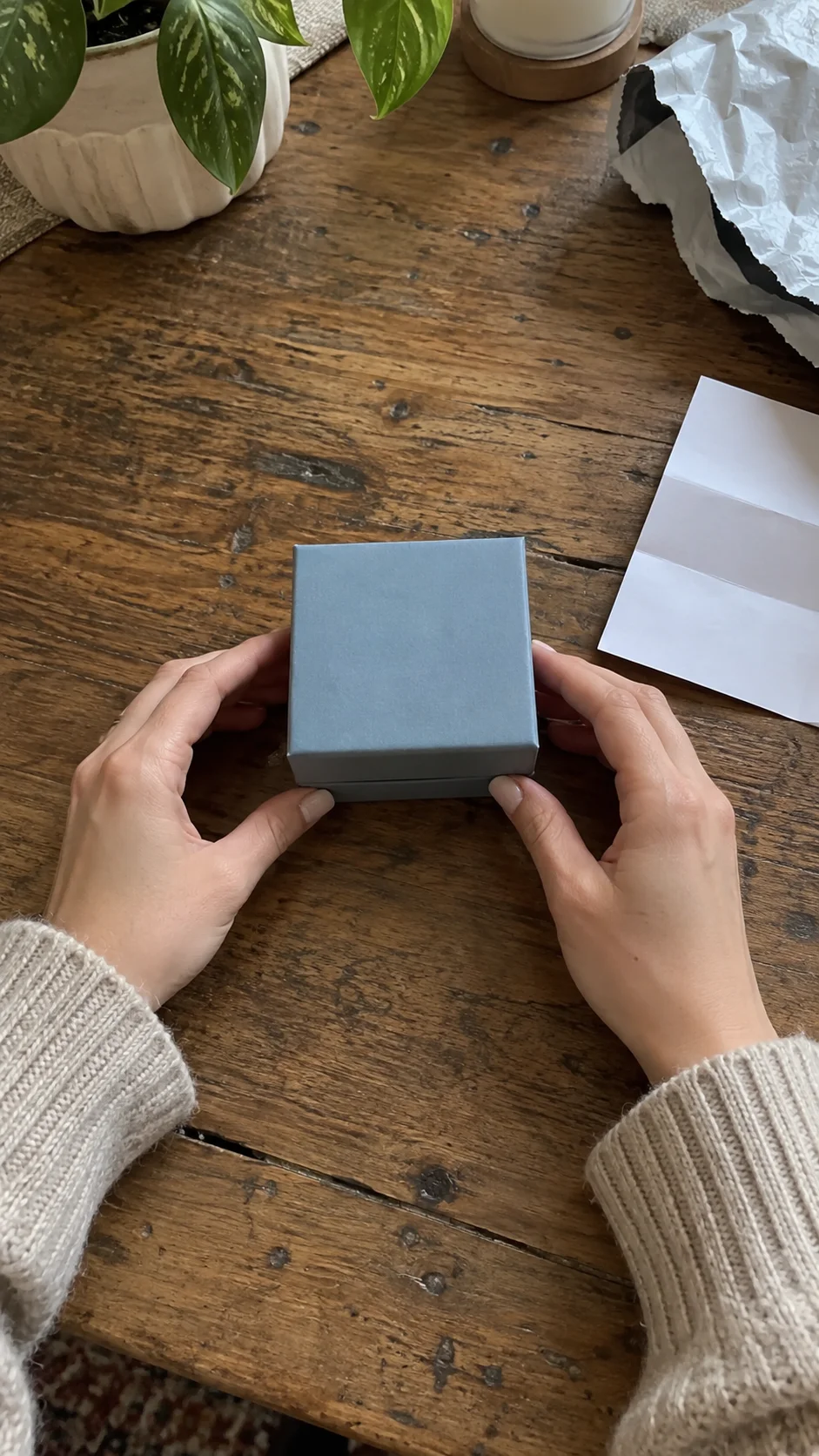
ugc-detail-unboxing — package open → product detail. Generated examples · results may vary.
Lifestyle / everyday placement
Best when the product should sit in a believable routine (desk break, tabletop, soft intro) without becoming a fashion film.
- Everyday desk direction (example from gallery patterns): Desk break headphones
- Soft product intro: Sunlit creator explainer
Keep the SKU description in the brief identical to the PDP colorway. Lifestyle lighting should not wash the logo into a blob.
Story (multi-scene)
Use Story on Create when you need a longer arc — Hook → Demo → Lifestyle → CTA — that a single short Video clip cannot carry. Write scene cards with the same SKU wording repeated in each scene. Review scene-by-scene before approving the whole Story. Credit estimates for Story are typically higher; treat it as a deliberate spend.
Product motion (optional scroll-stop)
When you want surreal or motion-led product worlds (still SKU-readable), browse Product motion templates such as Cardboard city builders or Droplet-to-product reveal. These are still generated AI UGC creatives, not testimonials.
Rejection criteria / kill checklist
Reject early. A bad draft that ships is worse than a credit spent on a clean reject.
| Check | Kill if… | Operator fix (change one variable) |
|---|---|---|
| SKU readable | Logo, label, or silhouette unreadable at phone width | Better crop / cleaner hero still / shorter clip |
| Hands / body | Extra fingers, fused knuckles, product floating without grip | Simpler hands-on template, shorter duration, or surface placement instead of grip |
| Color / colorway | Wrong bottle tint, fabric swatch drift, packaging that is not yours | Re-attach true PDP photo; name the color in the brief |
| Claim drift | Invented "results," fake review language, medical/financial claims you never wrote | Strip claims from the brief; keep action + tone only |
| Identity drift | Generic "beauty bottle" that is not your SKU | Stronger reference image; repeat brand cues in the prompt |
| Story continuity (Story mode) | SKU changes mid-arc, scenes contradict | Same SKU line on every scene card; fewer scenes before polish |
Rule of thumb: if you would not show the frame to a brand manager on a phone, do not download it for ads or organic. AI UGC is still your creative responsibility after generate.
FAQ
What is AI UGC?
AI UGC is generated creator-style content made with an AI UGC video generator. It is not authentic buyer UGC and not a real customer testimonial. Review outputs for SKU accuracy and disclose generated content where your channel requires it.
Does Clipin offer a free trial?
No. There is no free trial and no complimentary credit claim in this draft. If you want a paid try, the Experience Pack is $4.99 (one-time; see live details on /pricing).
How long can clips be?
Confirm on /create. Observed (2026-09-19): Video mode uses a duration slider roughly 4s–30s; Story mode uses chips from 15s through 5m. Template marketing defaults are often ~15s — that is not the Create maximum. Duration varies by model and settings.
What does it cost?
Shared credits across video, images, and voiceovers. As of the product baseline aligned with live pricing:
- Starter: $29/mo · yearly effective about $24.17/mo
- Studio and other plans: see /pricing
- Experience Pack: $4.99 one-time paid try
Live /pricing wins if numbers drift. Monthly credits do not roll over (stated on site).
Is AI UGC the same as testimonials?
No. AI UGC ≠ testimonials. Do not present generated clips as real customer footage.
Product photo to video — is that the same job?
Often yes in practice: many teams only have a still and need a product photo to video path into a creator-style clip. That is the core Create + templates workflow above — still generated content, still subject to the kill checklist.
Where should I start?
Open /create with one hero photo and a two-line brief, or start from a matching template on /templates. Review the credit estimate before you generate.
Start with your product photo
You already have the still. Write the action. Pick a format. Generate a draft. Kill what fails. Keep what keeps the SKU honest.
CTA: Create with Clipin →
Templates: clipin.ai/templates · Pricing: clipin.ai/pricing · Support: support@clipin.ai · Brand: @clipin_ai
For ads / paid-social compliance depth only: AI UGC Ads Playbook — this article does not duplicate that playbook's test matrix.